


Alec Egan: "Groundskeeper" at Vielmetter Los Angeles
Updated: Apr 30
By Nancy Spiller Alec Egan's painting "Dawn House," in his show "Groundskeeper" at Vielmetter Los Angeles, is tender, serene, and calm — a lavender and peach sky sheltering the triangular top of a house flanked by two palm trees and the tip of a cypress. In its companion painting, "Night House," the sky takes a sinister turn with layers of dark blue, sunset orange, and a roiling strip indicative of flames mixed with what might be smoke. It hints at something of what Egan, his wife, and two small children experienced in January 2025 when the wildfire took their Pacific Palisades home and his studio, which housed no less than two years' worth of work scheduled for multiple upcoming shows. "Groundskeeper" is his first solo show since that tragedy and his first show with Vielmetter.

"The dawn can represent such hope, and the sunset can represent something completely different," Egan says. He speaks with a boyish enthusiasm and clear-eyed intelligence. The Kenyon College creative writing graduate and former aspiring poet adds, "This is what I mean by showing and not telling. If one chooses to read my art through that lens, yes, that dawn was hopeful. By that night, I was looking up at this sky that was a multicolored fluorescent, weird, fucking sky, and it had a completely different feeling. So a lot can change in 24 hours." The bearded Egan, dressed in baseball cap, gray T-shirt, and brick green hoodie still looks like the rugby team captain he once was. He assures with a smile, "But the constant also of this house, where the interior is hidden behind these patterned curtains, is a big part of that story, too. And if you read it backwards, then the house exists in the dawn after that night."
Much can be read into Egan's unabashedly beautiful oil and Flashe paintings, with plenty of poetry, narrative, emotion, and memories lurking in their astonishing pile-up of meticulously rendered, obsessive floral patterns covering walls, tablecloths, lightless light fixtures, open or closed umbrellas and socks — busy backdrops to brilliantly colored tulip, dahlia, or chrysanthemum bouquets, some carved from Flashe, lending a third dimension.
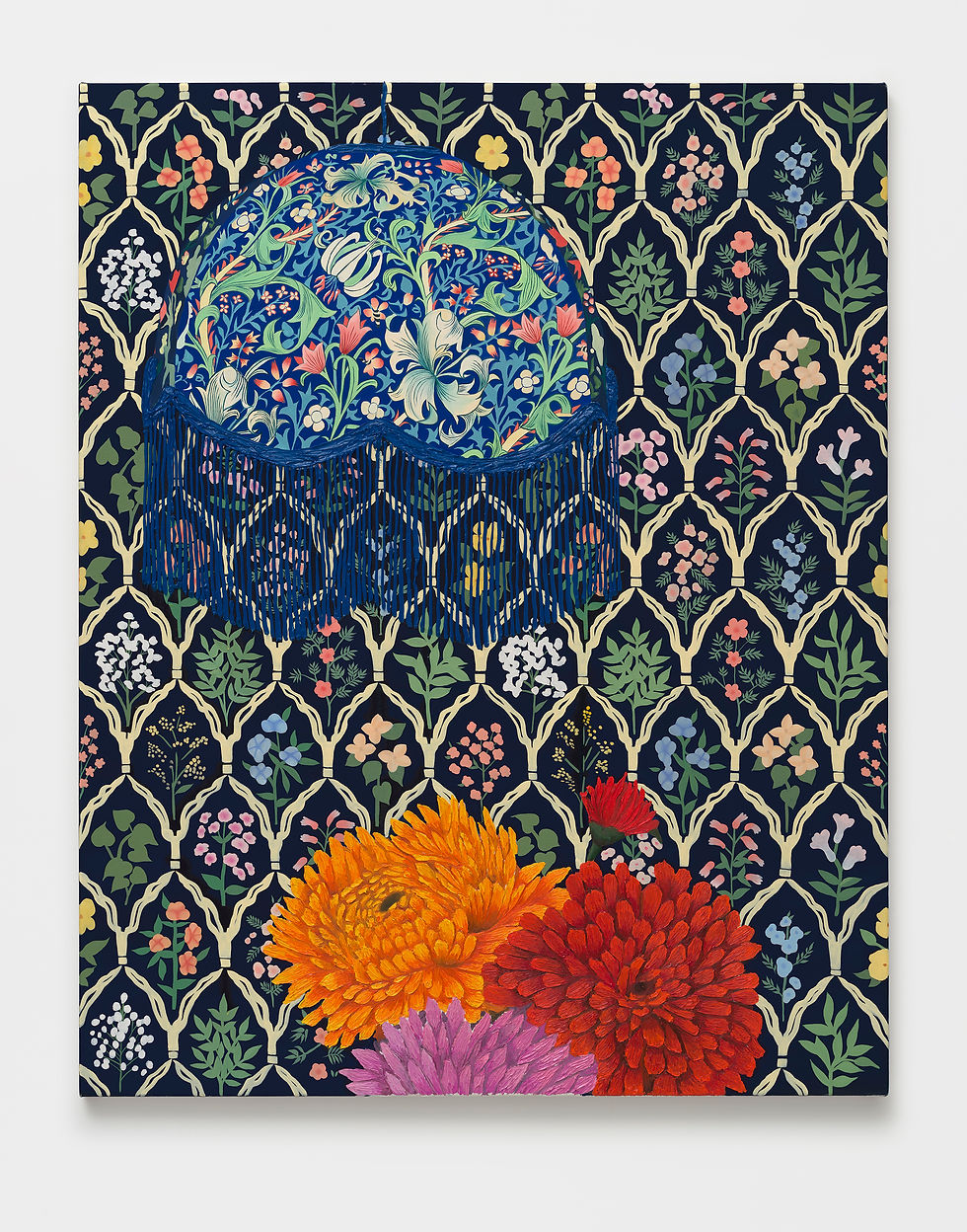
The outside world is sometimes let into these cluttered interiors, as in the painting "Flowers, Umbrella and Boat," where a window hung in floral curtains looks onto an ocean as a floral-sailed boat glides beneath a flaming sky; or, as in "Sunset Mountain," a single floral panel frames a window view of an imagined road as a car passes a snowy mountain lit by the setting sun.
None of the paintings literally reference a burning house, save for "Run," which is not only the painting's title but the title of the book splayed open on a lemon-strewn tablecloth. Beside it is a fruit-filled, chicken-shaped basket backed by an especially busy wallpaper — a picture of blissful domestic banality. The book's cover has a burning house about to be doused by a tsunami wave while a terrorized male clings to a floating log. This darkly humorous scene was prompted by Egan's five-year-old daughter while they occupied a "weird house" in East Hollywood those first few post-fire months. The Egans subsequently settled into a home in Santa Monica Canyon, while Alec took a separate studio in Santa Monica.
At the end of their East Hollywood street was a little free library. "My daughter was obsessed with it. This is what she brought home." He laughs as he holds up a book from the children's disaster series, I Survived. "It was too good not to paint. She's pulling out these deeply fictional books about disaster, and they're so relatable. Like, our life had become fiction."
Writing fiction and narrative was what Egan thought his life would lead to. Growing up in Pacific Palisades with his theater director father (Robert Egan, Producing Artistic Director with the Mark Taper Forum, 1983–2003) and actress mother (Kate Mulgrew, Star Trek: Voyager and Orange Is the New Black), he considered writing his primary form of expression, until he found himself in a "pretty rigorous" creative writing program for poetry at Kenyon College. He was disappointed to discover the freedom he'd favored in poetry was "filtered through this archaic, hierarchical, rigid system, that I couldn't really deal with very well."
It was during that crisis he discovered painting. It appealed to his physical nature. "I was able to still make things that were narrative, make things that had some linear sense to me. Painting saved me creatively."
His only writing these days, he confesses shyly, is in journaling.

He returned home to Los Angeles for an Otis MFA in 2013. His transition from writing to painting also included a number of years driving across the country in a van filled with typewriters and paints, looking for cheap working spaces. It laid the foundation for his subjects today.
"I spent a lot of time in the middle of nowhere. Burnt out, deeply impoverished towns in the Midwest. You'd see these floral patterns on farmhouses, and in towns. The industry was gone, and yet, there were these references to beauty inside their dilapidated homes. I saw those same patterns in my grandparents' Iowa farmhouse, and then I'd see them when I finally got to Brooklyn, in a thirty-year-old hipster's house."
He wondered what it was with humans that they felt the need to recreate the beauty of the outdoors in patterns inside their homes. And where did it begin, this taking of nature to create gardens, to make pictures for walls? Not to mention cutting flowers only to bring them inside to watch them die.
"It became this aesthetic choice we made as a civilization," Egan says, "to protect us from what? To distract us from what?" He considers the patterns he paints as not only beautiful but filled with "eerie" psychological underpinnings. "They're just so juicy," he says. "That's why I continue to work with them."

The man in his show's title painting, "Groundskeeper," looks both drained of all juice and remarkably like Egan. Stunned and overwhelmed, he melts into his garden chair, a floral-patterned blanket across his lap; next to him is an orange tree, a red Flashe net tightly gripping its plentiful fruit, its root ball wrapped in fabric, waiting to be planted. There's just one catch, Egan says. "There's no shovel or tool there. There's just no way to plant that thing."
Egan acknowledges an "ambivalence" in this replanting process. "That's why it's laden in all these patterns with the blanket." They're symbols of language and "the past you can't escape. It's weighing you, comfortably in some ways," he assures, "but weighing you into this chair." There's a great task at hand — an immense property to take care of — but the tools are missing.
He smiles as he speaks, gesturing with his hands. "Maybe it's the property of life, you know, whatever that is, with something looming that is both vibrant and beautiful, violent and terrifying." The smile goes impish as he shrugs. "That could be an L.A. sunset, or could be a fire, or it could be...just an existential crisis."
Alec Egan: Groundskeeper Vielmetter Los Angeles 1700 S Santa Fe Ave #101, Los Angeles, CA 90021 Through May 16, 2026 vielmetter.com
Nancy Spiller is an artist, author, and writing instructor currently living in Oxnard after losing her home to the Palisades Fire.


