Artist Spotlight: Adrienne Kinsella - The Jello Holds Everything
- Kristine Schomaker
- Jan 21
- 4 min read

Adrienne Kinsella starts her studio days with movement. Pilates or a hike in Griffith Park before the real work begins, because she's learned—after years of trying to muscle through—that her body needs to move before her art can. Coffee. Something to eat so her brain functions. Then the painting becomes "restorative, strangely restful."
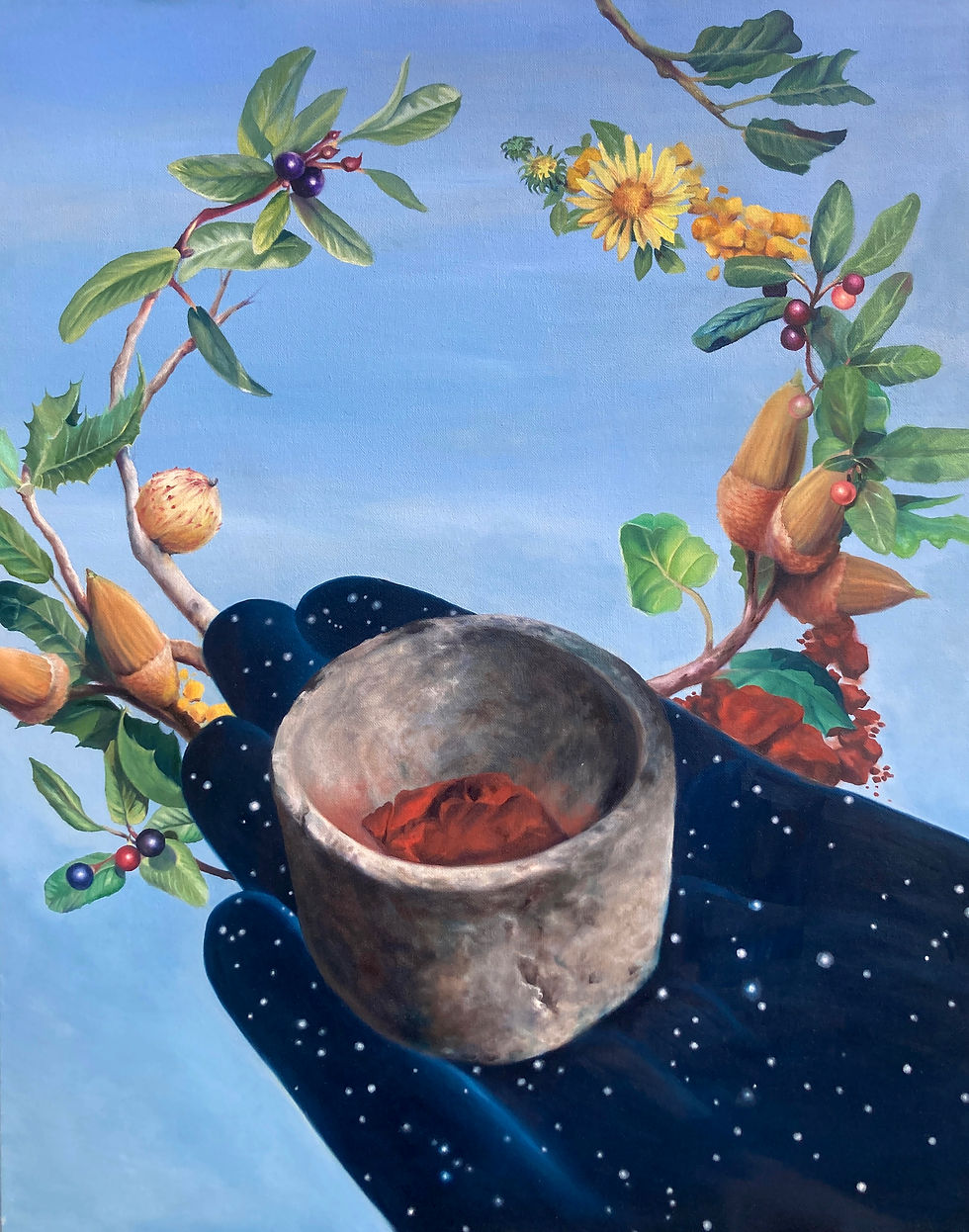
It's a practice built around listening to what works, which feels fitting for an artist whose work examines the slippery space between interior and exterior, past and present, what we show and what we hide. And right now, what she's showing is urgent: as a descendant of the Tongva Tribe of Los Angeles, her current body of work brings illumination to indigenous presence within the contemporary city.
"When encountering people in the city, I often hear them say, 'I didn't even know there was a tribe here,'" Kinsella explains. "As erasure has been an historical trend for LA's indigenous peoples, I feel a renewed passion to encourage people to understand our tribal presence within the contemporary."
When Jello Became the Monster
Kinsella's work has always grappled with Los Angeles's propensity to erase its own history. But over time, something shifted. The monsters that once populated her canvases transformed into something both more mundane and more unsettling: jello.
A sparkling, monstrous substance. Technically edible yet made of the unthinkable. Structural yet temporal. The perfect metaphor for a vanishing past, for the midcentury aesthetic that still haunts LA, for the feminine experience of being on display while simultaneously trapped.
"This rendered flesh, dressed up for consumption, temporarily conforms to a mold, but proves transitory—whether devoured or melted away," she says. "Jello can symbolize homey domesticity yet simultaneously feels alien; other and familiar all at once."
The translucent foodstuff does something else too: it reveals interior and exterior simultaneously, which is exactly what Kinsella's work does. Her paintings and drawings on frosted mylar invite viewers into inaccessible spaces where California native plants and animals share domestic interiors with solitary figures, where timelines collapse, where the psychological and physical occupy the same impossible room.

The Teaching Feeds the Making
Part-time professor at Otis College of Art and Design. That's the official title. But anyone who's talked to Kinsella knows teaching isn't just what she does between studio sessions—it's integral to who she is as an artist.
"I sincerely love teaching," she says, and you believe her. "It is an incredible honor to work with students and experience the hope of new generations developing their artistic voices."
Her students inspire her. So do her weekly hikes in Griffith Park, where air and plants and birdsong provide "a point of connection, a grounding with nature and a place within the city where the land is given a chance to breathe." Movement again—the body finding its way through space, creating conditions for the mind to follow.
The challenge is balance. Teaching can eclipse an art practice if you let it, so she disciplines herself to have dedicated studio days. Takes breaks throughout painting days for tea in the afternoon. Works on drawings in the evening hours. Answers emails and applies to grants during those "breaks" that aren't really breaks but necessary parts of being a working artist.

The Pile of Rejection Letters
Someone once told Kinsella: "You're not applying to enough shows or opportunities unless you have a pile of rejection letters on your desk."
It's the kind of advice that lands differently depending on where you are in your practice. For Kinsella, who came to art later in life—who returned to school with two children, built up from one class to a grad program at Cal State Northridge, earned her MFA during a pandemic—it's become a touchstone.
"Tenaciousness and perseverance are so vital in the creative arts," she says. "When tempted to give up, sometimes just taking a break or redirecting can help us keep going."
Her work embodies this persistence. The drawings build up slowly, covering one section after another. The paintings develop in stages—initial pass, assessment, additions if necessary. She's a planner, but she's learned that sometimes the plan changes once the subject is on the substrate. Art has a mind of its own.

What the Work Wants to Do
Empty, void, bland, bottled up—that's what life would be like without art, according to Kinsella. The visual expression of humanity is both gift and necessity, a way to process things that can't be released otherwise.
What she hopes to accomplish with her work: connection. A sense of awe. An appreciation of beauty. Maybe a moment of peace in the lightspeed pace of this cultural moment.
And visibility. That's the piece that feels most urgent right now. Bringing illumination to Tongva presence in Los Angeles, pushing back against the erasure that's been historical trend, encouraging people to understand indigenous peoples within the contemporary rather than relegating them to the past.
There's positive movement and awareness happening. And yet much work still to be done.
Kinsella's advice to artists starting out sounds simple but carries weight: "Look at all types of art, develop friendships not connections and keep making, even when you feel discouraged. It will hit sooner or later."
The jello holds everything—the struggle, the belonging, the search, the hope. Sparkling and monstrous and utterly familiar. Revealing what's inside while displaying what's outside. Temporary but structural enough to hold form, at least for now.
That's the work. That's what it means to keep painting, to keep teaching, to keep making visible what's always been there but too often unseen.

Adrienne Kinsella is a fine artist and educator who teaches at Otis College of Art and Design and Cal State Northridge. Her work can be seen at adriennekinsella.com.