


Bruce Weber: Try a Little Tenderness
By Melanie Chapman
Timed in conjunction with the Taschen publication "My Education," the first book-form retrospective of photographer Bruce Weber's multi-decade career, the new exhibition now on view at Fahey Klein Gallery, Bruce Weber: Try a Little Tenderness, is worth more than one visit.
Likely due to Weber's genre-defining success as a fashion photographer for Calvin Klein, GQ, Vogue, etc., particularly at its height in the 1980s and '90s, the line for the recent gallery opening stretched down the block and by attendance alone had to be measured as a hit. As is usually the case with openings, it is difficult to see the actual work on the walls thanks to the packed room full of friends and fans, people who seemed dressed to impress and perhaps hoping to be discovered by someone, anyone, best of all the famed photographer himself, who was graciously in attendance. Thus, it is understandable that one might share space with the 60+ framed images but come away without a sense of having actually seen the work. Thankfully, a fellow attendee's passing comment outside the show, remarking on the significance of Weber's influence in bringing queer iconography to a mainstream audience "back in the day," prompted a revisit to Fahey Klein once the crowds were gone and one could have the space and breath to take in the body of work and appreciate the more subtle messages of this heartfelt show.

The strength of Weber's photography is not just the beautiful men and women he has documented in various stages of undress, but also his gift for composition and ability to represent moments that feel both classic and spontaneous. Weber's black-and-white work is gorgeously printed and occupies prominence in this exhibit, yet his gift with color is also well represented in a small grouping of seven images that make the case for shooting on film; the saturation of tones evokes the summers of one's youth.
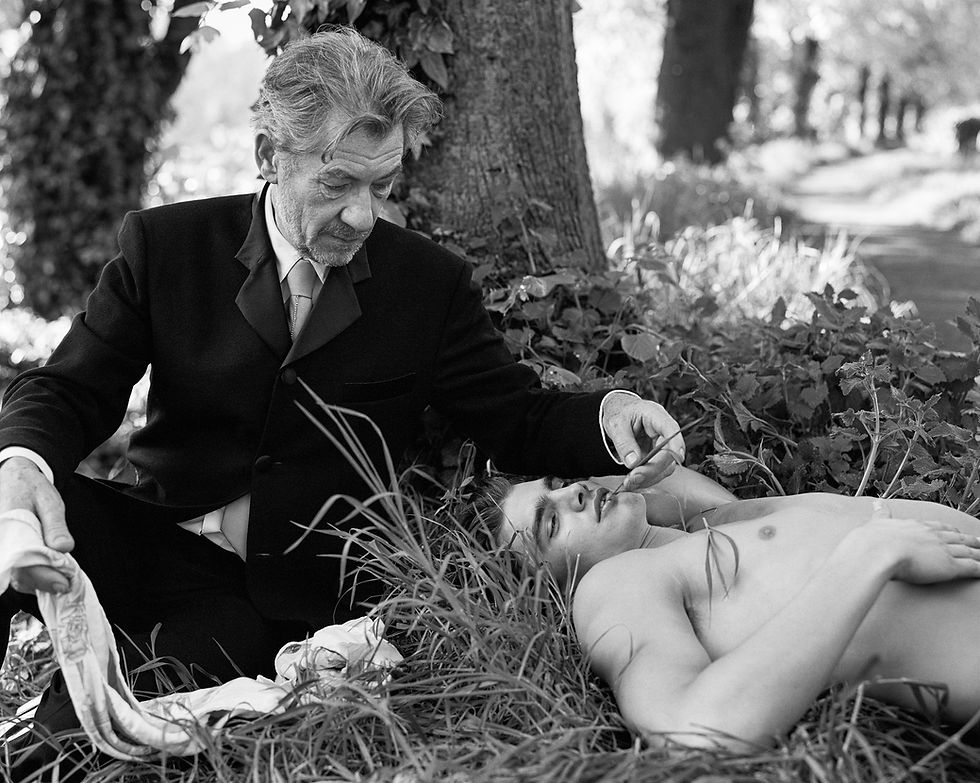
Two images in particular embody the theme of tenderness around which this show was built. One is of the actor Sir Ian McKellen, seated in a sun-dappled landscape gazing down at the languid face and nude torso of Peter Johnson, as exquisite an example of male beauty as one may ever hope to gaze upon. McKellen holds a blade of grass to Johnson's lips, the elder man enraptured by the fawn-like youth displayed before him. This image evokes paintings such as Narcissus by Gyula Benczúr (1880) and Michelangelo's The Creation of Adam fresco in the Sistine Chapel (1508–1512). While the setting of the Old Brompton Cemetery in London is not explicitly represented, one can sense the specter of death, as McKellen is dressed in a dark suit and tie while Johnson's eyes are closed in a repose that could be read as sensual relaxation. This image could also be read as old age mourning the eternal sleep of one's own youth. It is a gorgeous photograph that clearly demonstrates Weber's command of craft and appreciation of art history.

Due to its placement, Weber's photograph of musician Nina Simone is not featured as one of the first images the viewer experiences upon entering the gallery. However, it can serve as another lynchpin by which to appreciate the entirety of the show. Shot rather close-up in a pose that evokes a somewhat confrontational pietà, Simone looks directly at the camera while embracing a young man whose face is obscured. The image is tender yet revealing of a lifetime of hardship and sacrifice. Simone was an extraordinarily talented and intelligent Black woman who self-identified as bisexual and experienced bipolar disorder in her later years. She also suffered no fools, and her career trajectory was impacted not only by racism and sexism but by her willingness to call that out. Perhaps more than any other image in this show, this portrait of Simone reflects the dichotomy of Weber's own career and the challenges each artist faced in pursuing an ideal in a world that does not always accommodate originality and independence.
One can find many examples of tenderness throughout this show, as a majority of the images contain moments of embrace or even the slightest hint of contact between subjects. Be they fathers and their children, siblings, friends and possible lovers, or people and animals, the recurring gesture of touch and the vibration of space between those who inhabit Weber's photographs resonates throughout. Though Weber does not identify as a "queer photographer," it is understandable why that community would want to claim him as their own. Weber does not shy away from showing us the beauty of two men at their physical prime in an erotic setting, neither does he eroticize all forms of connection. Rather, his camera offers us glimpses of affection that is universal among beings who love each other, and at the moment that he clicked his shutter, Weber preserved on film his appreciation for the joy and preciousness of life.
Many of the people in Weber's images are no longer with us, including elders such as Allen Ginsberg, Christopher Isherwood, Elizabeth Taylor, and Nelson Mandela, but also represented are luminary talents lost too soon, such as Jeff Buckley and River Phoenix. To visit Fahey Klein Gallery during the quiet hours, when throngs of admirers are not in attendance, offers the viewer enough space and quiet to appreciate the soundtrack of jazz musician Chet Baker playing in the background — an appropriate choice given Weber's relationship to Baker through the making of the acclaimed documentary Let's Get Lost.
The images Weber has made throughout his long career are undeniably beautiful, and they do not read as exploitative, especially as curated for this show. Fathers embrace their children, brothers and friends enjoy moments together. Not every touch or gesture is sensual, but all of them are infused with meaning.
Bruce Weber is best known for photographing gorgeous men and women, many of them famous, some of them "just" beautiful specimens of humanity seen undressed, tussling in fields, leaping into fresh bodies of water as if Olympian gods responsible only to feeding their appetites for pleasure. Perhaps in the spirit of such pleasure, in 2017–18, Bruce Weber faced accusations of inappropriate behavior toward some of his models, and though those cases were either eventually dismissed or settled out of court, those scandals did negatively impact his career.

In response to what that experience meant to Bruce Weber as a person, and with prescience on the part of the exhibition organizers as to the time we now find ourselves living through, this meaningfully curated selection of Weber's images persuasively makes the argument that tenderness is in fact worth seeking, celebrating, and trying — forever and for all, again and again.
Bruce Weber: Try a Little Tenderness Fahey Klein Gallery 148 N. La Brea Avenue, Los Angeles, CA 90036 April 9–June 6, 2026 bruceweber.com faheykleingallery.com
Melanie Chapman (she/her) is a Los Angeles lens-based artist and writer. In addition to writing art reviews for Art and Cake, Melanie is a contributing editor to Photobook Journal and is currently working on a documentary film as well as an ongoing photo essay featuring outreach activists in the local transgender community. Melanie is also a freelance photographer, photo assistant, and co-studio manager at the Los Angeles Center of Photography in DTLA. Find her on Instagram @tipheadpictures.


