


No Dust to Settle: Amir Zaki at Diane Rosenstein Gallery

Amir Zaki
No Dust to Settle
Diane Rosenstein Gallery
April 4 - May 9, 2026
by Jody Zellen The saying "waiting for the dust to settle" might refer to when things will calm down and return to normal. It could be said that "the dust never settles" and there is no state of definitive calmness because everything is in flux, both in life and in art. This might be taking the personal into account by reading too much into the title of Amir Zaki's current exhibition, his third with Diane Rosenstein Gallery. That being said, Zaki has titled his exhibition No Dust to Settle. It is a play on words and offers insight into the entirety of Zaki's photographic works. Throughout his long career he has photographically examined the built and the natural landscape of California, often creating interventions that render the real surreal. His subjects have included piers, empty skateparks, trees at night as well as commercial signage devoid of text. Using digital tools and embracing what is possible with technology, Zaki makes subtle changes to what the camera documents: compositing numerous images to distort perspective or adding or erasing information to augment the architecture and its environs.
The photographs that make up No Dust to Settle are black and white images of public libraries shot in Orange County, CA. Many of these were designed by noted post-war architects such as Richard Neutra or William Pereira. At first glance, the image Buena Park, La Palma Library, #14 (all works 2025) is a documentary style black and white picture of Pereira's library (built in the 1960s). At the bottom of the vertical image sits the library — a low horizontal one story structure. In front of it, is a large tree that extends into the sky, towering over the building. The are no people in the image. It strangely lacks any human presence, as well as any signage which is unusual for a public library. For those familiar with Zaki's work, the image begs the question: what has Zaki done? Has he altered the scene in some way?
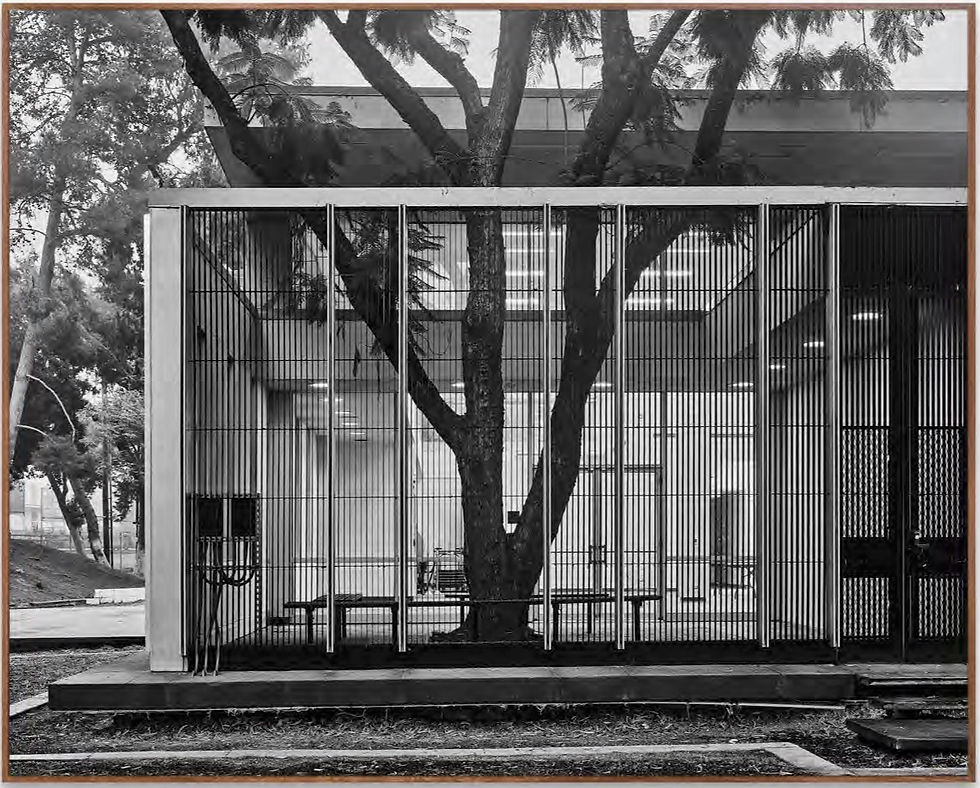
When moving to another image, the same question arises. Looking at Fullerton Public Library, Hunt Branch, #6 it appears to be a precisely framed picture of the building surrounded by trees and grass. The overhead lights are on, illuminating the interior which can be seen through the clear glass windows at the entrance. Inside are tables and chairs but again, no people or signage. Uncannily, there are also no reflections. The same holds true for another photograph of the library shot from a different vantage point. Here, Zaki delights in presenting one of the outdoor atriums depicting a robust tree confined within the space.
In other images from the series, Zaki celebrates classical, avant-garde and modernist as well as brutalist architecture in its purest state. Zaki often focuses on design details— that which makes the building unique. For San Juan Capistrano Library #13, he frames the image so that a black pole situated in front of the building appears as a semi-blurred interruption in the foreground of the picture. It splits the composition in half, calling attention to the symmetrical roof top behind, the muted sky above, and a closed black back door all mysteriously missing any of signage. The library, designed by Michael Graves in 1982-83, is an example of postmodern architecture, drawing from myriad styles to reflect the history and culture of the location. Comparing Zaki's photograph San Juan Capistrano Library #1 to a historic image taken from approximately the same vantage point, one clearly sees Zaki's erasures — the word Library is gone, as are numerous window reflections.

Fountain Valley Library #6 depicts a section of Ralph Allen's 1991 cantilevered, curvilinear concrete structure. Zaki has digitally removed the signage on the door and windows to turn the building into an abstract composition of curved and rectangular shapes in varying shades of gray. Because Zaki is known for digital additions as well as erasures, one might intuit that the large white bunny in front of the Newport Beach Public Library at the center of his photograph, Newport Beach Public Library #17 was a digital addition. But this is an actual bunny sculpture, a companion to the fourteen located in Newport Beach's Civic Center Park.
While Zaki alters the landscapes and cityscapes he photographs, his goal is not to make them unrecognizable. Rather he embellishes, transforms and reflects on locations throughout southern California to speak about history, architecture, and the changing climate. He uses photography to frame "reality" but then goes further by transforming that reality into something else. Sometimes his interventions are quite obvious, other times — like in the No Dust to Settle photographs, his manipulations are more subtle. Zaki combines the formal and conceptual to create evocative and thoughtful images that add to the ever changing discourse around digital photography.
Jody Zellen is an artist and writer living in Santa Monica, CA . For more information please visit www.jodyzellen.com.
Diane Rosenstein Gallery
1504 N. Gardner Street
Los Angeles, CA 90046
424-428-4717


