After Zero: Leonie Weber's Cardboard Ruins

By Kristine Schomaker
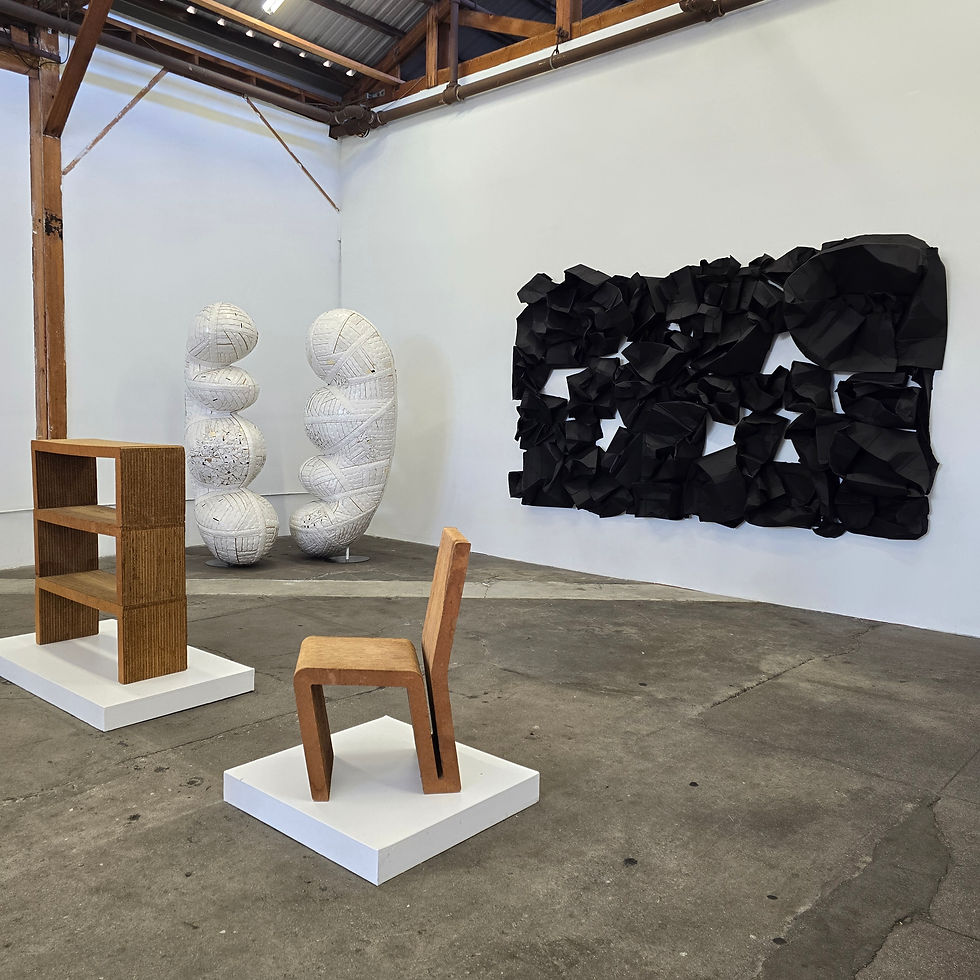
Standing in front of Leonie Weber's cardboard relief at Wönzimer and my brain's trying to sort through everything it's reminding me of—Abstract Expressionism, Nevelson, Bontecou, constructivism, Malevich's Black Square. All these art history touchstones showing up in what's essentially crushed Amazon boxes painted black and mounted on a wall.
From a distance it reads as pure gesture—black forms exploding across the surface. But get closer and you see the construction. Each piece of cardboard deliberately crumpled, layered, every fold and buckle a decision. Not action painting. Action building.
The action's still there though, completely physical. Instead of throwing paint Weber's throwing her body weight into cardboard. You can feel the energy—stomping on boxes to flatten them, crushing them with her hands, bending the material past its breaking point, pushing pieces together like kneading dough. Full-body engagement, the same thing Pollock brought to painting but redirected into sculpture.
Weber's treating these boxes like clay—pushing, pulling, forming through direct manipulation. Except clay wants to cooperate. Cardboard resists. It has structural integrity, ideas about how it wants to fold. Making it do this requires real force, sustained pressure. You have to really work it to get these deep folds and dramatic shadows.
Louise Nevelson's black walls are the obvious reference—that monochrome commitment unifying disparate elements. But there's a reversal. Nevelson put objects in boxes, creating compartmentalized order from found wooden fragments. Weber takes the boxes themselves—constructs designed to contain and organize—and deconstructs them into gestural collapse. The container becomes the content.
Constructivism's in here too, but turned inside out. The Russian constructivists believed in building new forms for new societies, using industrial materials to create utopian structures. Weber's using the detritus of late capitalism—Amazon boxes, packaging of endless consumption—to build something that feels more like ruins. If constructivism was about faith in material and form creating better worlds, this feels like what happens when that faith collapses.
Which gets us to Malevich's Black Square. That painting was supposed to be zero, the end point, painting reduced to absolute essence. Malevich called it "the icon of my time" and hung it where a religious icon would traditionally go. Death of representation, death of the old world, everything reduced to pure form and feeling.
Weber's working in that same territory of black-on-black negation with a crucial difference. Malevich's square was smooth, absolute, a void. Weber's blacks are all texture and depth, full of information. If Malevich's Black Square was about emptying out, reaching zero, Weber's relief is about what comes after zero. All this accumulated stuff—cardboard, packaging, endless material excess—crushed into black forms that refuse to disappear completely.
There's nihilism in that maybe. Taking objects designed to protect and deliver consumer goods, destroying their function, painting them black, mounting them on walls. The boxes can't contain anything anymore. They can only be themselves, stripped of purpose, transformed into pure visual material.
But if it's nihilism, it's nihilism that still bothers to make beauty. That still cares about composition, light and shadow, how the eye moves across surface. That tension between the impulse to destroy (boxes crushed, broken, rendered functionless) and the impulse to create (those same boxes carefully arranged, painted, elevated to art).
The religious dimension Malevich invoked hovers here too. What are Weber's black cardboard forms saying about what we worship now? Consumption? Convenience? Endless packages arriving at our doors? There's something almost sacrificial in how she's treated this material—taking the stuff of daily commerce and transforming it through destruction into something demanding contemplation.

The surface has this unexpected textile quality—painted cardboard draping and folding like fabric. Crushed taffeta maybe, or that deliberately wrinkled material gathered at the bottom of formal dresses. Your brain knows cardboard is rigid, has corners, folds at right angles. But Weber's crumpling it, crushing it, making it behave like something with give, with drape. Dressmaking with Amazon boxes.
Lee Bontecou's reliefs from the 1960s—those aggressive, void-centered works made from canvas and metal suggesting bomb craters, machine parts, something simultaneously organic and industrial. Weber's piece shares that push-pull between construction and destruction, but cardboard changes the stakes. Bontecou was welding. Weber's working with trash she's physically wrestling into submission.
The crumpling creates shadows and planes that feel almost geological. Canyon walls, rock formations, erosion patterns. Or wreckage. Then that fabric association comes back—gathered silk, crushed velvet. The corrugated lines add rhythm within chaos like pleating or smocking. Each line a record of pressure applied, material forced into new configurations.
The material insists on its own history. You can see where boxes were taped shut, where address labels were torn off, where cardboard got wet or crushed in transit. Then Weber adds her own history—the crushing, the bending, the transformation.
Malevich wanted the Black Square to be absolute. Weber's blacks are anything but. Full of information, history, evidence of making and unmaking. If Malevich was reaching for the void, Weber's acknowledging we can't get there. Too entangled in material, in stuff, in endless accumulation. Even our attempts at negation—painting everything black, reducing form to gesture—can't escape the thingness of things.
Scale matters. Takes up serious wall space, commands attention like an Abstract Expressionist painting would. But made from something we throw away every week without thinking. That gap between monumental and disposable, high art gestures and literal garbage—that's where the work generates energy.
If constructivists thought they could build utopia with geometric forms, if Malevich thought he could reach absolute zero and find god or absence of god there, then Weber's cardboard reliefs are happening in the aftermath of all those projects. Working with what's left—materials of failed utopias, impossibility of pure negation, stubborn persistence of stuff even when we try to reduce it to nothing.
We live in a world where cardboard shows up at our doors constantly, then disappears into recycling bins without us really seeing it. Weber makes us see it. Makes us contend with the sheer volume of it, the sculptural possibilities hidden in something we've been trained to ignore. She does it by making cardboard do something it shouldn't be able to do—drape, gather, create visual luxury we associate with materials that cost exponentially more.

The monochrome black coating does formal work and conceptual work. Makes all the individual pieces read as one thing while creating shadows that let us see each piece's distinct form. Removes graphics and text, universalizing the material while preserving its essential cardboard-ness. Black on black, texture on texture, material manipulation becoming the entire point.
Something almost apocalyptic about the piece. All this accumulated packaging, painted black, clustered on the wall like aftermath of something—explosion, collapse, system breaking down. But organized into composition. Given form through sustained physical effort. Art that references both destruction and decoration, industrial waste and deliberate craft.
If there's nihilism here, it's nihilism that still bothers to arrange things beautifully. If there's a void, it's a void filled with texture and history and evidence of hands working material. If there's negation, it's negation that can't quite complete itself, keeps getting interrupted by the stubborn presence of cardboard, shadow, form.
Cardboard: Infinite Possibilities curated by Ann Weber runs through January 30 at Wönzimer Gallery, 341-B S Avenue 17, Los Angeles. Gallery hours Thursday–Sunday, 12–7 PM. Artist talk January 15, 7–9 PM.