


SELF PORTRAITS AS EXISTENTIAL AFFIRMATIONS
“Where Do We Come From? What Are We? Where Are We Going?”
~ Paul Gauguin
"I paint self-portraits because I am so often alone, because I am the person I know best."
~Frida Kahlo
NOTE: This essay is about Tony Pinto’s brilliantly conceived and curated “Self/not Selfie” exhibition currently at the Golden West College Gallery. As its name indicates, the exhibition focuses on artists’ private images of themselves (i.e., self-portraits)—not on contemporary Smartphone photographs used to document where people went, how they looked and what they did (selfies). Featuring 90 works by 85 artists, the self-portraits deal with a wide range of media, styles, and content. Unfortunately, I have not been able to see the exhibition in person and am working from photographs for this essay. Every review of an art exhibition comes from personal opinions, and this one is not only limited by its subjective perspective. It is also limited by its dependence of reproductions, rather than proceeding from experiences of the original artworks. I apologize in advance for these limitations and for the fact that I can write about only a small percentage of the gifted artists in the exhibition.
By Betty Ann Brown
Historically, artists like Frida Kahlo usually created self-portraits in private, working alone to re-produce what they saw in the mirror. Rembrandt used his numerous portraits to trace the ageing process and explore psychological insights. These self-portraits functioned as affirmations of existence: “I was here. I created this image of myself.” In his Arnolfini Portrait, for example, Jan van Eyck included a shadowy image of himself in a doorway and glossed it with Johannes de eyck fuit hic 1434 (“Jan van Eyck was here 1434.”)
Other artists included themselves in paintings of imagined events. Raphael’s depiction of himself as Apelles in the back corner of The School of Athens (1509-1511) is obviously imagined. Raphael lived in Renaissance Italy, not Ancient Athens. Portraying himself in the distant past was not intended to convey his physical presence. Instead, Raphael’s image was more like a pictorial signature: “I did this.” Both the “I was here” and the “I did this” of historic self-portraits are found in the Self/not Selfie exhibition.

Some of the artists produce works that echo historical precedents. Cornelia Hediger’s self-portrait Contemplation is inspired by Ernst Ludwig Kirchner’s Erna with a Cigarette from 1915. Hediger painted herself with a cigarette, then added photographic material and collage. It is an extraordinary example of mixed media pairing the past with the artist’s presence in this postmodern era. (Another artist who does this is, of course, Yasumasa Morimura. He creates mixed media images of himself inserted into historic masterpieces from Leonardo’s Mona Lisa to Goya’s The Sleep of Reason Produces Monsters, an etching from 1799.)


Many of the Self/not Selfie artists portray themselves in time-honored media. Amy Ahlstrom’s self-portrait entitled Mercurial is a quilt done in bright Pop Art colors. Her textile composition includes two images of herself framed by curving arrows, pointing to the changes of weather (rain drops, clouds, lightning)—and to parallel changes in her personal moods. Kerri Sabine-Wolf’s Unraveling is a mixed media involving oil paint, graphite and charcoal. She depicts herself four times, tying and untying the fragile threads that hold her (and all of us) together. There is a history of double self-portrait paintings: Frida Kahlo, Egon Schiele, Ernst Ludwig-Kirchner, and Claude Cahun are just a few artists who have explored their identities with double images. But the use of four self-images can be read as a postmodern reference to multiples selves. Philosophers Jean-Francois Lyotard and Michel Foucault both wrote about the fragmented, heterogeneous and non-unified selves produced by our mass media-dominated postmodern society.

Kerrie Smith painted herself on a circular canvas (a tondo) with serpentine hair. She used gold leaf to enhance the painted form, much like medieval icon painters did. Smith happens to be a physically beautiful woman, so it’s interesting to see her portraying herself in an image evocative of the Ancient Greek snake-haired monster Medusa. On closer viewing, the spiraling forms turn out to be tree branches. As such, they underscore Smith’s connection with nature…which is the subject of so much of her oeuvre.

Roberta Levitow also created a self-portrait that includes gold leaf. Her Lysol Lady portrays the artist as a postmodern icon. She holds a can of Lysol disinfecting cleanser. Behind her, two small angels hold up stone tables that read “Hope” and “Fear.” Gold text in the blue sky reads “Anno 2021,” reminding us that the painting was created during the COVID epidemic, when some of us were fastidious, even obsessive, about disinfecting every surface in our homes. The painting of the artist’s hair recalls the thick, loose brushstrokes of Vincent Van Gogh. The postmodern nature of Levitow’s composition derives from the juxtaposition of the contemporary topic of a bespectacled woman holding a cleanser with the expressive brushstrokes evocative of the late nineteenth century.

Marina Claire’s When Every Particle of Dust Brings Forth Its Joy is an oil on canvas painting of the artist’s face hidden behind her ringed and tattooed hands. Her long gray hair drapes down the composition and one eye peaks out to encounter the viewer’s gaze. The use of gray and black make the painting look almost photographic…but close viewing reveals its texture of smooth brushstrokes. Claire’s self-portrait refuses to reveal the artist’s appearance. She is present but she evades our visual consumption.

One of the most interesting aspects of Self/not Selfie is the use of modern media and alternative processes, from X-rays to plastic paper. Lori Pond presents herself as composed of photographs and, in her case, medical X-rays. Six X-rays are hung over a color photograph of her nude body. Her physical form is established by the metallic implants inside with her fleshy exterior. She is clearly a postmodern girl—a cyborg combining the human and technology. (I think of the work of feminist scholar Donna Haraway….and as someone who has metal in her left hip, both elbows and left foot, I totally understand how medical interventions can affect and change our body images.)

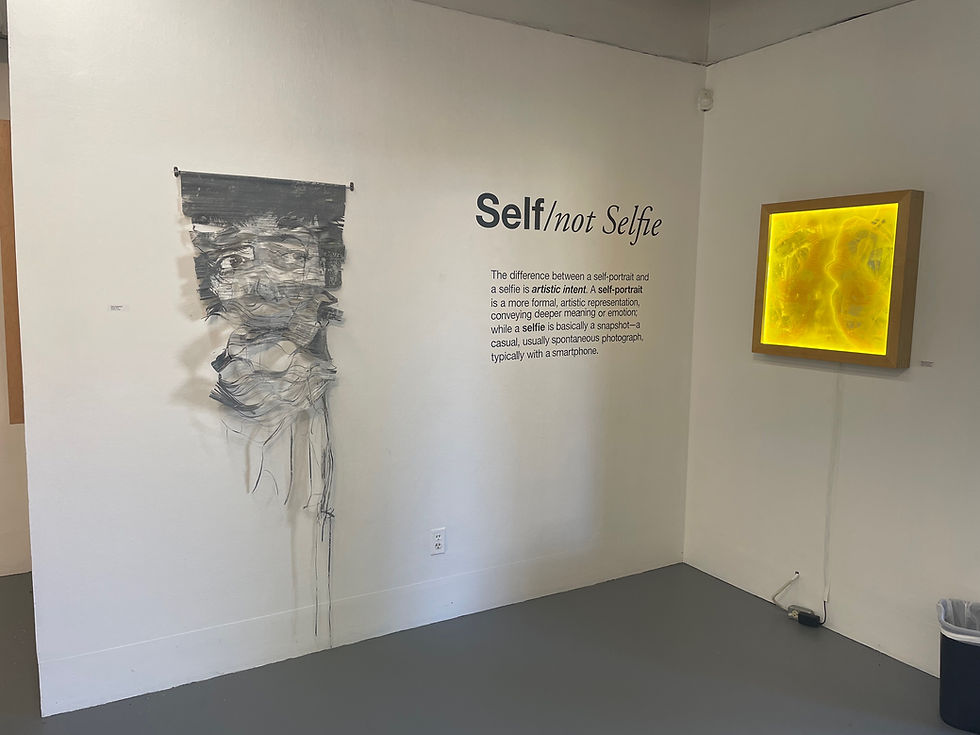
Katie E. Stubblefield started by painting a fairly traditional self-portrait on Yupo, a translucent paper made of polypropylene. Then she shredded it and hung it on a vertical wall so that it drapes like broken venetian blinds. The parallel lines of the horizontal shredding recall the horizontal scan lines of early television screens (which started as very low resolutions through Cathode Ray Tubes.) Blending the self and technology, Stubblefield builds a mysterious cyborg self that eludes easy understanding.

One hundred and eighty-six years after it was patented by Louis Daguerre, photography is so ubiquitous that we tend to forget it is the quintessentially modern medium. Many of the Self/not Selfie artists base their works on photography. Louis Jacinto’s Starting Over from 1979 is a black and white photograph of the artist standing by a chair piled with books. He holds an open volume in front of his face, thus obscuring the most easily identifiable aspect of his body. The book he shows us is Masculine/Feminine and the books stacked on the chair also address sexual identity. The artist has hidden his penis between his legs, so his genitals are sexually ambiguous. In other words, he is presenting himself as existing outside stereotypical gender characterizations.

Dennis Keeley’s Self Portrait About Time depicts the artist holding a photograph of a younger man. At first, I thought it was a depiction of the artist’s younger self. But Keeley’s statement about the work indicates it’s a photograph of his father at age 17. The family resemblance is powerful but ironic: the artist never knew this younger version of his father. The medium of photography reaches back to an unseen past and reminds us of the medium’s capacity to show us what happened before we were born.

Valentina Aproda Maurer created an environment composed of hundreds of cut black and white photographic images scattered over a vertical surface. She then dressed in similar black and white fragments and posed herself stepping out of the wall. I am reminded of photo mosaics produced by Chuck Close and other contemporary artists. I also am reminded of the thesis of Ridley Scott’s Blade Runner, in which replicants are given histories by means of photographs. And I think of Susan Sontag’s discussions of how we construct ourselves, our lives from photographs.

Laurel Paley’s self-portrait is a cluster of small color photographs scattered on the wall. All of them are details of human flesh, of the artist’s pink body. We see nipples, scars, and folds of skin. We also see images of unspecified body parts. Is that a hip? An elbow? A fatty stomach? Paley asks us to see the body—her body—as comprised of anatomical fragments. We are all aware that some people objectify others by focusing on certain parts of their bodies: some men focus on women’s breasts; some women focus on men’s torsos. In either case, they are thinking of bodies as things, rather than as thinking, feeling, loving entities.
Today’s photographic selfies are taken in public, confirming that the photographer was there, that she participated in the event or activity that is the context of her image. Taking selfies proves what she looked like, where she went and what she valued. They affirm her existence and portray it as good.

Kristine Schomaker covered a wall with hundreds of 4” x 4” selfies taken on her Smartphone camera. Each of the 365 selfies documents her presence at events (often exhibition openings) with her many friends. Together, these selfies compose a self-portrait: the artist is constructed by her myriad relationships. Schomaker’s immense wall of selfies functions as document of her presence. It also serves to construct her identity in the context of her community, what the Hawaiians call her “ohana,” her family of choice.

From traditional paintings to new media, from a single image of the artist’s face to the construction of her identity from in X-rays, the self-portraits in the Self/not Selfie exhibition document these artists’ individuality and their existence. Curator Tony Pinto has assembled a remarkably varied group of images that point to who and what we are as human beings. The Self/not Selfie artworks do not only give us visual pleasure. (June Wayne always used to say that good art should “kiss your eyes.”) They also provide important insights into who we are as a species. And in these traumatically distressed times, we need all the insight we can find.
Self/not Selfie is on view Wednesday-Friday from 10am-2pm through November 14th. Golden West College Art Gallery Room 108 15751 Gothard St Huntington Beach CA 92647


