Dean De Cocker
By Betty Ann Brown
"The idea becomes a machine that makes the art."—Sol LeWitt
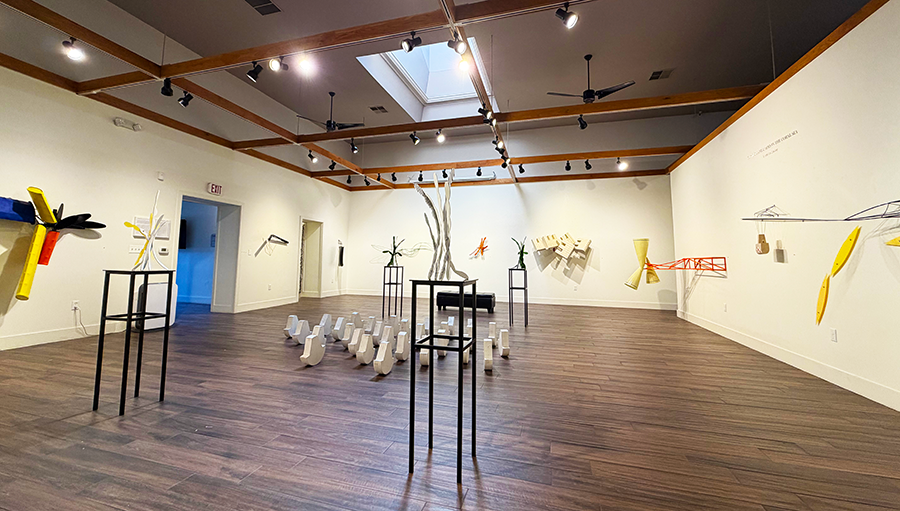
Dean De Cocker creates richly conceived, exquisitely crafted, and visually delightful artworks that shuttle between abstraction and conceptual representation. He has long been drawn to machines, from bicycles to motorcycles, cars to airplanes, and formal echoes of these devices appear in his current body of work, exhibited at the Visual Arts Center in the small Central California town of Visalia.

De Cocker began his conceptual exploration of machine-inspired sculpture with a balsa structure that recalls the wings of his childhood airplane models. He titles the piece 8 a.m., The Beginning and dates it 1987–2024 to indicate that although he started it four decades ago, he has continued to work on and exhibit it until very recently. Precisely built, it not only references wooden models, but also the interior structures inside actual metallic wings.

Welcome to the Pacific (2012) is based on propellers, specifically those from the fighter planes American pilots flew over the Pacific Ocean during World War II. Four elegant ovoids meet to create two bowed shapes that are attached to an orange openwork platform. The ovoids are constructed of wood and painted in beige and brown stripes; their curvilinear formats and striped surfaces recall the work of Minimalist painter Frank Stella.

Beige-and-brown stripes are also featured in De Cocker's Running at Full Tilt (2012), a fiberglass and wood sculpture suspended from a black metallic armature. The crenelated shape of the fiberglass element recalls architectural outlines; the curving tops look back to the artist's airplane wings. Similar crenelated shapes appear in an earlier work, Currents and Winds (2002), that includes five smaller striped components suspended on the wall like scattered puzzle pieces. The five pieces are covered in canvas and evoke the kind of upholstery that covers the seats of cars and other vehicle interiors.

In addition to his sculptures, De Cocker also produces ink drawings on vellum and digital prints on plexiglass. The prints in his 2024 series are named after US battleships sunk during the Japanese attack on Pearl Harbor in December 1941. Oklahoma (BB-37) honors the Nevada-class battleship by that name that was capsized by torpedoes, its wreckage never found. Black and white ribbon-like strips are clustered atop a similarly black and white background. Surrounding the black and white shapes is a thin chartreuse-green line surrounding them like hems or other fabric edgings. The chartreuse is only visible up close, but it serves to highlight the shapes even from a distance.

Although Oklahoma (BB-37) represents a concrete object, it does so without mimesis, instead abstracting the immense form into small geometric elements. De Cocker's exhibition Cyphers and Codes in the Coral Sea referred to encrypted military messages as well as the 1942 battle between US and Japanese forces in the Pacific Theater of the Second World War. The displayed artworks demonstrate the artist's skill in taking historic objects and conceptually translating them into formal compositions in both two and three dimensions. His abstracted aesthetic components, whether inspired by airplane wings and propellers or automobile and architectural details, constitute a unique vocabulary of forms, consistently recognizable in his sustained oeuvre. De Cocker speaks an abstract art language that draws on multiple real-world sources. Its oscillation between abstraction and representation, as well as its formal and conceptual resonances, deeply fascinate and engage viewers.
Dean De Cocker: Cyphers and Codes in the Coral Sea closed August 1, 2026 at the Visual Arts Center, Visalia, California.
Betty Ann Brown is an art historian, critic, and curator based in Los Angeles.