


Susan Silton: Diving into the Wreck
By Jody Zellen
Los Angeles Municipal Art Gallery
September 3–November 22, 2026
Susan Silton has never been an artist attached to a single medium. Her practice, which spans more than forty years, interweaves photography, design, performance, sculpture, video, audio, and installation. Working as a graphic designer in the 1970s and ’80s shaped her visual acuity and formal sensibilities. Her production is conceptually strong and visually coherent and very little is left to chance. It is a delight to see the range of her output so carefully installed at the Los Angeles Municipal Art Gallery. The exhibition traces the scope of her career, presenting just the right amount of works to inform, but not to overwhelm.

Upon entry, viewers are immediately drawn to the bright orange title wall where the 1972 poem Diving into the Wreck by Adrienne Rich is displayed. The poem sets the stage for the exhibition, metaphorically using a dive into the sea as a point of departure to explore the ups and downs of life. With that in mind, the first object visitors encounter is one of Silton’s newest works. In front of your face (2026) is a large wrecking ball suspended from the ceiling. This mixed media sculpture is inscribed with lines from Rich’s poem, curiously juxtaposed with an audio recording from the 1999 film Any Given Sunday where Al Pacino plays a coach giving his team a pre-game pep talk. Silton subtly changes the wording to make it gender neutral to address everyone, and directs the speech away from football and into the realm of politics. The wrecking ball is meant to represent the state of current affairs.
Silton has never been shy about asserting her politics, her feminist viewpoint, and her self image into her works. She is upfront about having had cancer and two works address this: You Sound Sexy (2000) and Life, Drawing (2014). In the two-channel video You Sound Sexy, a diverse group of performers are filmed mouthing the words “you sound sexy.” Focusing on their lips, they are paired with a clip of a hand activating the rims of drinking glasses where the vibration causes a steady high-pitched sound. The work examines gender expectations as Silton was befuddled by the compliments she received when she began to speak in a lower voice due to changes in her vocal cords.

A later bout with cancer led to Life, Drawing, where Silton posed as a model at Los Angeles art schools. Wearing only striped pants or a tutu, she allowed the participants to view and sketch her breastless upper body (the result of a double mastectomy in 2011) in a performance transcending vulnerability and overcoming any sense of insecurity. On view are both her costumes and the drawings made by more than fifty participants. Silton unabashedly dances in Requiem (2016/2026), a video installation in one of the back galleries. Reflecting upon and reacting to the shootings at Pulse Nightclub in Orlando, FL in 2016, Silton pairs a running list of the names of those who perished in the tragedy with a film of her dancing to the song “Turn the Beat Around.” Again, she challenges what might be expected, to bring joy back into the sense of loss.
The performative aspects of Silton’s practice include her The Whistling Project with The Crowing Hens, a collective of women who whistle themes from iconic male-centric films. Excerpts from The Whistling Project can be heard via speakers installed throughout the gallery. Another dynamic work activated by participants is In everything there is the trace (2013). Here, Silton has created an installation where ten manual typewriters adhered to interlinked custom tables are positioned in a circle. Throughout the exhibition, Silton will host typing sessions where individuals will re-type without ink the text of Octavia Butler’s Parable of the Sower (1993). In a previous presentation, John Steinbeck’s The Grapes of Wrath was used. The empty chairs and the inkless typewriters function as a staging area. They signal a kind of absence, yet even when activated — because the typing is done without ink — Silton foregrounds that which is invisible.
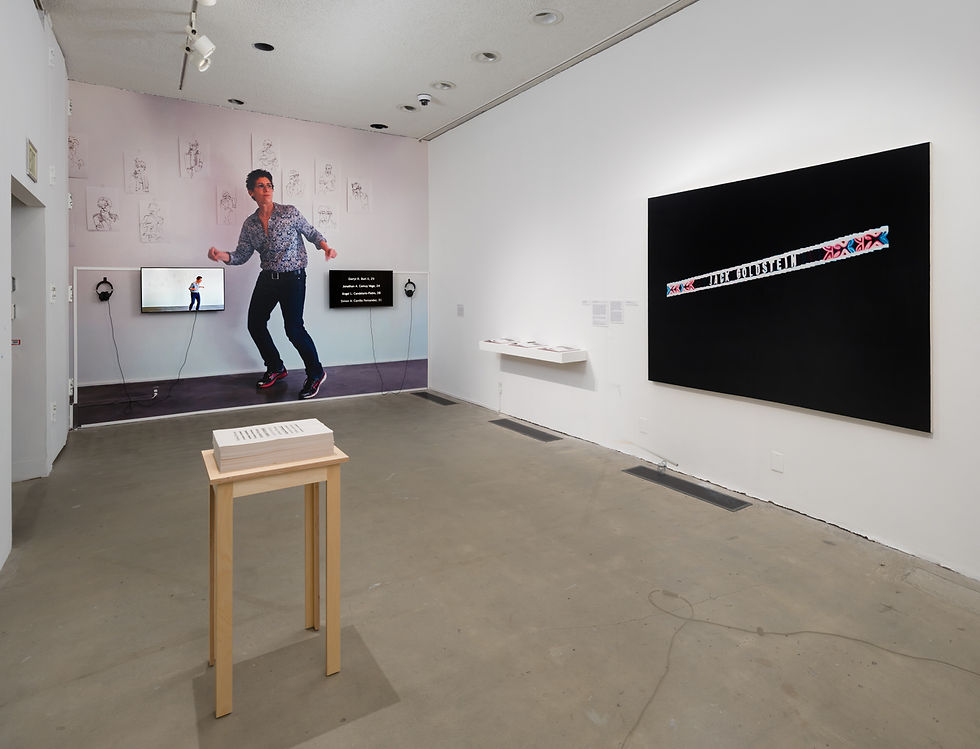
Among her many photography projects are self-portraits made on flatbed scanners as well as photographs of tornadoes purchased from storm chasers and then digitally manipulated and printed at a small scale to contrast the tremendous size and impact of the actual twisters. She has also documented tented houses undergoing fumigation, and in a series titled Aviate she blurs and abstracts images of birds, printing them large to further obfuscate their origins. Displayed in a back gallery are numerous examples of Silton’s design work, including posters, postcards, and numerous books that illustrate Silton’s acute understanding of the relationship between image and text and the power of the word and the picture both together and separately.

Silton looks hard and thinks outside the box while taking chances and unapologetically speaking her mind. She has collaborated with poets, writers, dancers, videographers, and other artists to create evocative works that draw from the past and look to the future while trying to make sense of the discombobulated social and political milieux of the now.

Susan Silton: Diving into the Wreck September 3–November 22, 2026 Los Angeles Municipal Art Gallery 4800 Hollywood Boulevard Los Angeles, CA 90027 lamag.org


