


Playing With Fire: Rediscovering Doyle Lane
By Victoria Thomas
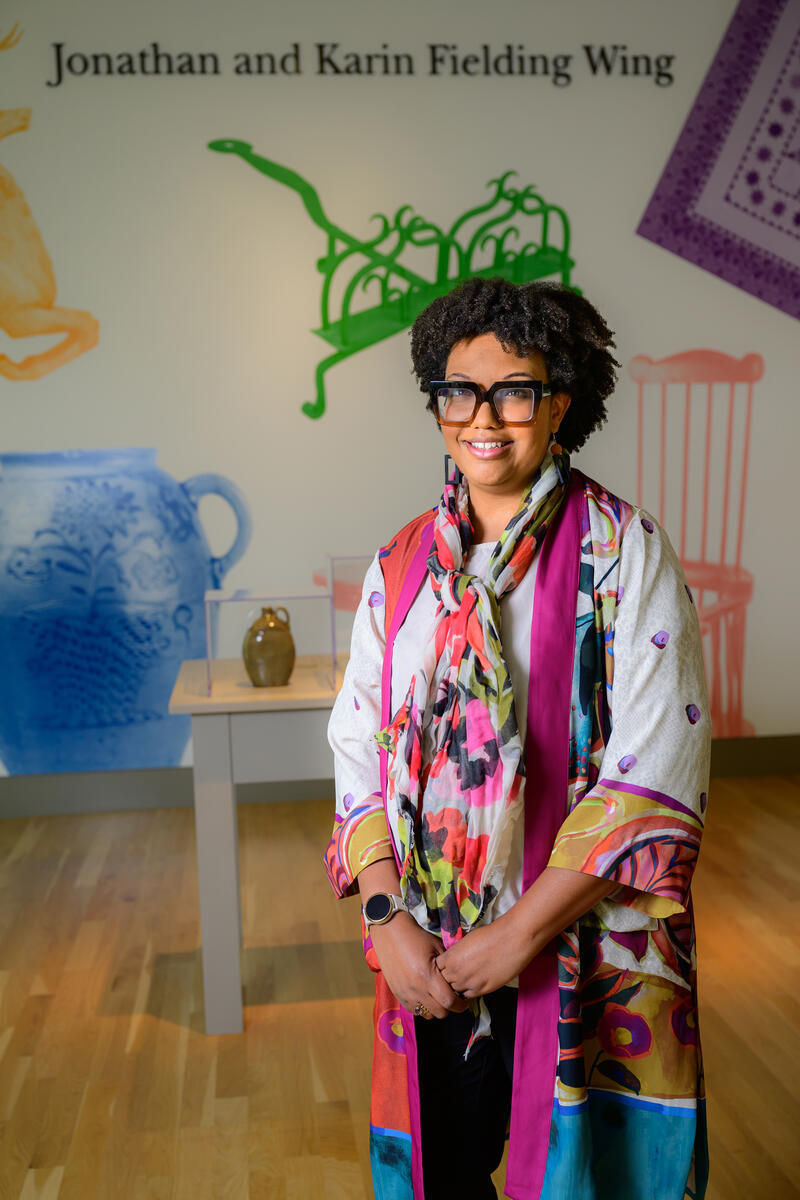
Lauren Cross, PhD is the Gail-Oxford Associate Curator of American Decorative Arts for The Huntington. The gifted artist, author, and scholar moves through the world of material objects with a detective's nose for sleuthing out lost context and hidden figures, and a Griot's gift for connecting narrative dots to unearth treasure. She is the unstoppable force behind the first major museum retrospective to explore the untold history of ceramic innovator Doyle Lane, with more than 100 Lane artworks on view at The Huntington in San Marino from September 13 through March 1, 2027.
Dr. Cross is the author of the exhibit catalog Doyle Lane: Master of Clay, featuring never-before-published photographs and interviews, handsomely designed and bound with a textured cover to suggest the highly tactile nature of Lane's clay paintings and other work. Dr. Cross closes her Introduction by writing "As I have worked to elevate the legacy of this exceptional American artist, righting the many wrongs that Lane experienced has become my greatest motivation."
She was briefly moved to tears at the September 10 evening preview of the exhibition, as friends of Doyle Lane, collectors, gallerists, and family filled the plaza outside the exhibit. A swampy dusk fell, reminiscent of Lane's New Orleans roots as the guests enjoyed luxe small bites. Monarch butterflies flitted in The Huntington's milkweed plantings, and wobbly green chafer beetles buzzed low through the humid heat, occasionally bonking into the black-tie celebrants. These visitations are reminiscent of comments made in the Kyle Provencio Reingold documentary film which accompanies the exhibit, where friends report that hummingbirds representing Lane's spirit continue to visit and claim his home studio property in El Sereno.
Dr. Cross said to the crowd: "When I witness this outpouring of generosity, from all of the creative people who worked with me on this project and all of the collectors and donors who made it possible, these are the same people who were compelled by Doyle Lane's story, and determined to hold on. Not only because of his underrepresented genius, but because of who he was as a human being."

Lane grew up in the Jim Crow South, losing his parents at an early age and leaving his N'awlins home at age 23 in 1946 to seek opportunity in Los Angeles. As his life took new form, he purchased a 1920s house in El Sereno which served as his residence, studio, and showroom, a space which Lane modified using his considerable woodworking skills — skills that also came in handy to stoke the woodburning stove lined with his own tiles, and skills perhaps gleaned from his carpenter father, who built the Lane (originally spelled Laine) family home in New Orleans. The artist also experimented with wood as a medium, creating large murals with sections of lumberyard knotholes.
Dr. Cross challenges us to examine Lane's daring body of work and seemingly unbreakable will within the context of the Black experience. His operating style is reminiscent of Hannibal Barca's 218 BCE response to his generals who insisted his plan to cross the Alps (with elephants, of course) was impossible. Hannibal is said to have responded "Aut viam inveniam aut faciam": "Either I will find the way, or make the way." Anyone who has faced a brick wall at midnight has whispered this vow, and for centuries it has been a silent mantra in the hearts of Black Americans.
Dr. Cross travelled to New Orleans and various other locations as part of her wide-ranging research, including more than 20 interviews, uncovering surprising connections which seem more divined than merely serendipitous. As a framework observation, she says: "Early on, galleries did not support him, and certainly did not champion him. In postwar Los Angeles, Black artists had no access to opportunities in the fine arts world. Interviews with Lane in the 1980s reveal that he remained pessimistic about Black artists gaining equal standing in galleries and museums."

But Lane exhibited a coping style familiar to those who have refused to be crushed by those brick wall midnights: he hustled. In her catalog, Dr. Cross references Lane's upbringing in New Orleans as a probable source of his entrepreneurial spirit, a setting he described in interviews as "the gumbo of life." Dr. Cross writes, "A key trait of hustle culture in African American communities is using obstacles like injustice as fuel for more purposeful work."
Dr. Cross suggests in her text that when Doyle arrived in Los Angeles, his reception among the city's upwardly mobile, assimilating Black community may well have been frosty. Dr. Cross writes: "His accent, and his eclectic demeanor and style, might well have made him stand out among those who did not necessarily welcome the distinctive culture of New Orleans...(with middle-class Black Angelenos) noting differences in the migrants' education and social standing and expressing fears that these newcomers might hinder the progress of middle-class Black people in the region."
More heavy-handed discrimination was soon to follow. Lane recalled with distress the experience of being assaulted by Pasadena police while he was installing a mural outside a client's home. The homeowner arrived to find two sheriffs standing over Lane spread-eagled on the front lawn. Although the client, banking consultant Rudy Estrada, is Latino, the surrounding Pasadena neighborhood was primarily white and decidedly affluent, leading to an assumption that Lane was an intruder — an illustration of the inherent bias, mistaken identity, and presumed guilt experienced often in communities of color.
On even more sanctified ground, in interviews Lane flatly calls out the much-lionized ceramic artists Otto and Vivika Heino, with whom he studied and worked, as overt racists. These are but two examples of the injustice which Lane must have encountered, although he chose not to be constrained by the experiences. On the contrary, although his work steered clear of explicit sociopolitical messaging, Lane continued to resist and rise simply by making his art. As a Southern-born-and-raised, closeted queer Black man, perhaps there were simply too many dangerous battles to confront more directly.
Lane's weed pots — wheel-thrown, using high-fire clays and low-fire glazes — nestle in the hand beneath an organic, funky skin of bubbles, bumps, dots, drops, drips, spatters, glyphs, scratches, and notches that feels ready to crawl, melt, morph, and take on new forms to tell its secret story. One fights the urge to lick them.

There is an initial resemblance to the seductive porcelain "feelies" made by Arizonan Rose Cabat. Cabat's calling card: her satin-matte glazes, with any irregularities sanded off to a consistently sleek finish, a sharp contrast with Lane's more complex textural stories.
Now that his weed pots change hands for many thousands of dollars, Lane emerges as an acrobat of wit, intuition, and extraordinary agility, navigating setbacks and barriers with an athlete's endurance and a dancer's grace, able to pivot with life-saving improvisation on the wire. Based upon comments from those who knew him, perseverance and pure drive in the form of an unflagging work ethic, along with humility and flexibility, allowed him to sustain the blows and keep on pushin' (with props to Curtis Mayfield and The Impressions).
In 1951, Lane enrolled in Los Angeles City College (LACC) and majored in ceramics. A fellow Black student told him that ceramics were for white people. Lane didn't listen.
Through LACC's Employment Service Program, Lane landed a job with the industrial chemical distributor L.H. Butcher Co., where he worked as a glaze technician until 1960 when the company was sold. The intervening eight years provided an advantageous venue where Lane acquired deep technical knowledge with which he began to riff freely. This setting, where he formulated, tested, and perfected the scientific chemical compounds of hundreds of unique glazes, provided the genesis of his own signature textural and color treatments, often described as "volcanic" and "orange peel."
Lane's work emerged with what Dr. Cross calls "distinct Africanisms," starting with his acidic, equatorial, perhaps Pop Art color palette which departed from the neutral tones then in favor among American ceramicists. A further signature: his use of glaze as a raised, three-dimensional sculptural element versus a flat, illustrative tint. Among Lane's practices was a willingness to push kiln temperatures higher than recommended when glazing, resulting in charred edges and evocative burned areas suggesting the crusted brûlé, Cajun-blackened, and gratin de riz dishes of deep Louisiana.
Across the eons, far pre-dating paint on canvas or fresco, texture has long played a dominant role in African expression, from ritual keloidal scarification to the truly fantastic plasticity of African-origin hair, both means of asserting identity and transmitting coded cultural and societal meanings and motifs. Both intimately human examples rely upon inner visions, skilled touch, pressure, and dexterity as well as tactile patternmaking, evident not only in Africa's histories of designing effects upon human skin and coiffure as an artistic medium, but also in the astonishing gallery of iron, bronze, brass, gold, ivory, and wooden objects of such refinement that generations of colonials insisted that only white men could possibly have made them.
Sadly, Lane's years at L.H. Butcher Co. most likely damaged his lungs through daily exposure to toxins, notably asbestos, according to legal records on file regarding the company. Later, his own work on the improvised patios of his home studio further exposed him to an array of unchecked poisons — metal vapors, sulfur oxides, free crystalline silica, lead, cadmium, manganese dioxide, barium carbonate, chromium compounds and more, from which today's ceramicists protect themselves using NIOSH-approved particulate respirators, high-powered exhaust systems, and other technologies and safety practices not available to Lane.
Unfazed by resistance from every corner, early in his career Lane set out with his first edition of affordably priced weed pots in a wooden box and went door-to-door with them in the Pacific Palisades and other tony zip codes. This humble form of outreach soon led him to architectural firms, where he was met with interest absent from fine arts galleries at the time. While other ceramicists provided industrially-produced clay artworks for public buildings, Lane hand-built, fired, glazed, and reglazed uncounted thousands of tiles to create murals like the 17-by-8-foot, burnt-orange example originally commissioned by architect Welton Beckett in 1964 for Mutual Savings and Loan in Pasadena, now restored and installed in the courtyard of the June and Merle Banta Education Center, part of the Steven S. Koblik Education and Visitor Center at The Huntington.

The 4,876 rectilinear tiles used in the multi-paneled piece — not counting the many seconds that Lane eliminated — are not strictly identical in size or density of pigment coverage. This is significant to Lane's oeuvre in that Lane considered himself a perfectionist. Indeed he was, but he defined "perfect" on his own outlier terms. Sameness was never the goal. His assessment of perfection was far more nuanced than mere uniformity, which can easily be guaranteed by a machine.
Subtle irregularities in the murals create a shimmering effect close to textile, or to the supple, folded-foil tapestries of El Anatsui. Similarly, Lane's radiant turquoise-and-gold 1966 mural now housed at the Crocker Art Museum in Sacramento suggests a swath of royal Kente re-rendered in a more aquatic color palette. Dr. Cross notes that Lane's dozen or so enormous corporate mural commissions proved sufficiently lucrative to liberate him into a life devoted purely to artmaking.
Toward the end of his life, worsening respiratory problems and the loss of a finger while pushing his old pickup truck up a hill made the demanding physical practice needed for Lane's large-scale works impossible, and so he turned to ceramic bead jewelry, informed by Native American jewelry making. Local shops and Pasadena's iconic Folk Tree gallery sold the individual beads for a dollar apiece, knowing even then that the beads would soon become highly collectible.

Two women, both Black ceramic artists, both currently too fragile in terms of health to withstand further interviews, stood by Lane and guarded his assets during his lifetime in Los Angeles. Their names are Cynthia Folette Jackson, a personal friend to Lane for more than three decades, and Theresa "Tracy" Williams, a former LAUSD educator. Cynthia was a registered nurse who frequently drove Lane to his medical appointments at the Veterans Administration hospital.
"They cared for him. They looked after him like family," says Dr. Lauren Cross, noting that Williams located rare photographs, slides and prints, along with a 1988 cassette-recorded interview with Lane, which are central to this retrospective. "They held the story together, because Black women are preservers of the culture."
Doyle Lane: Playing With Fire The Huntington Library, Art Museum, and Botanical Gardens 1151 Oxford Road, San Marino, CA 91108 September 13, 2026 through March 1, 2027 thehuntington.org
Victoria Thomas writes about pop culture and social justice. @miss_vickums


