


From the Leather Dungeon to the Mountaintop: The Bergtatt of Catherine Opie
By Victoria Thomas
Photographer and ceramic artist Catherine (Cathy) Opie first shocked and rocked the fine art world with her self-portraits during the late 1990s. Today, her decades of work — often termed confessional — now serve as context for the far more enigmatic Holding Blue installation, on view at Regen Projects through July 3.
The Los Angeles-based artist identifies as a leather dyke, lesbian cowboy, an elder, and as "Mama Cathy," with a mustachioed male alter-ego named Bo. Opie is the Lynda and Stewart Resnick Endowed Chair in Art and a Professor of Photography at UCLA. Her work garnered the Smithsonian's Archives of American Art Medal in 2016, and she was the recipient of a Guggenheim Fellowship in 2019.

While many other artists documented lesbian, gay, queer, and kink lives including the fetishized netherworlds of BDSM, Opie dared to place herself directly before the lens. She showed skin. In fact, literally incisive, she used her own fair, flushed skin as a raw and bleeding canvas, a dermal manifesto of piercings and cuttings that spoke of the cruelty of the cis world as well as the artist's own deepest longings for belonging, family, and home.
In Self Portrait/Cutting (1993), a childlike image of two skirted stick figures smiling in front of a little house, complete with a curlicue of chimney smoke, is cut into Opie's back. In Self Portrait/Pervert (1994), the word "pervert" is carved into her chest while dozens of hypodermic needles neatly inserted through the skin bristle along each arm, shoulder to wrist. The artist's face is fully enclosed in a blackout leather bondage mask, symbolically silencing herself and reducing her identity to a mere label during the plague years.
Opie has referred to this self-portrait as her "Henry VIII moment," and the formal pose against a lush tapestry background is deliberately referential to the royal portraiture of Hans Holbein the Younger.
The scarring created by the Pervert cutting remains visible in Self Portrait/Nursing, where she cradles her naked infant son suckling at the breast. A tattooed band of Viking/Celtic zoomorphic design encircles her right biceps, elevating her strength as woman and mother into the realm of the mythic. And yet skin to skin, we also feel the vulnerability of both parent and child.
Given the potency of these visual statements, Holding Blue accosts us with the mystery of tranquility rather than confrontation. Drawn by memories of her Ohio childhood overlooking the blue haze of Lake Erie, the artist spent the first two months of 2024 road-tripping along the base of Norway's mountains chasing the "blue hour." The resulting images are divided by the artist into "Cliché" and "Vernacular" groupings, and the monumental alpine views are almost entirely devoid of human presence.
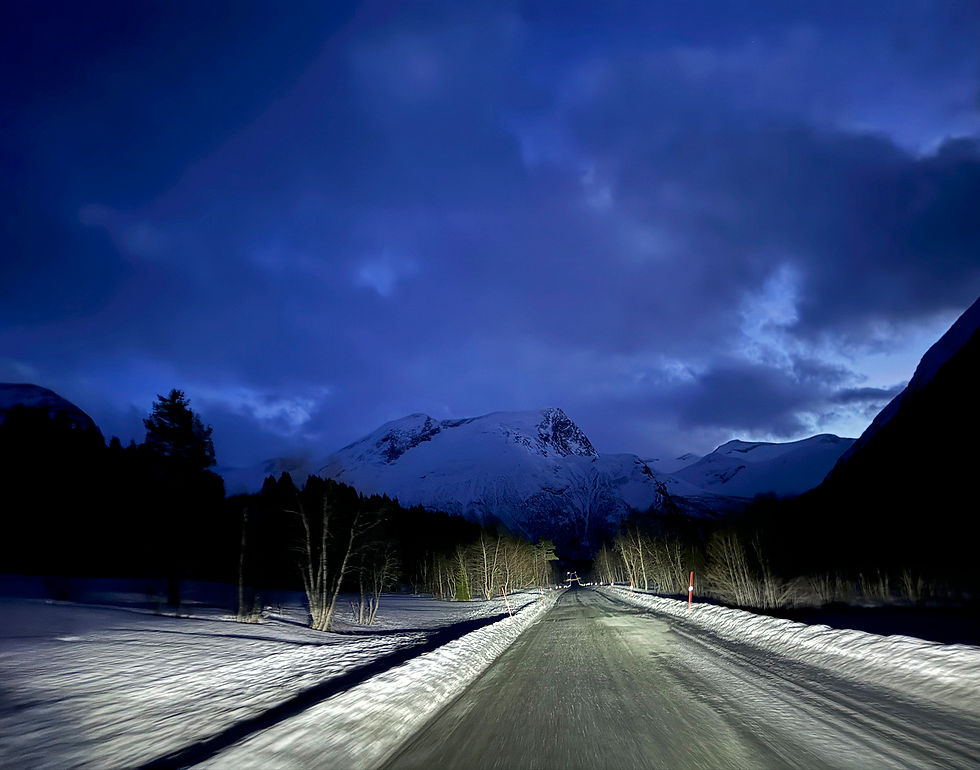
This approach to empty spaces was previewed in Opie's 1994–1995 series Freeways, which is absent of both cars and people, as well as her 2001 series capturing views of Wall Street as vacant as a ghost town.
A large-format "Cliché" image called "Munch sky" presents a molten swirl of purple and amber, while smaller images in the "Vernacular" grouping depict a solitary figure at an SUV, a lone horse, snow-dusted houses, and the iconic staves of an old wooden church, complete with fierce dragon finials like those on the prows of Norse longships, poised to fend off evil spirits who come too close. We see snow shoveled into a pile, clearing an apartment house walkway. A shot of a grocery stall displays traditional flatbread and the gourmet, liver-based premium cured sausage known as Arnoldpølsa, a local cult favorite.
The Norwegian word "Bergtatt" literally means "mountain-taken effect," and this sensation radiates from these huge, cerulean-blue prints which are entirely faithful to the camera originals, without alteration of any kind. Bergtatt is along the same lines as "Shinrin-yoku" (forest-bathing), but with a whole lot more Norsk darkness: the term originally referred to being enchanted and lured away into the frigid peaks by trolls.
Without foreground scenery to create depth of field, we are confronted by the absolute nature of the Norwegian landscape with no marker to indicate human scale. The effect is, perhaps, like stepping into the resolute presence of the gods. The mountain neither questions nor answers. No explanation is given, nor is one possible.
The radical work that first put her on the art-world map — including photographing every depiction of blood on view in the Vatican — is often accompanied by trigger warnings when exhibited. Even in the most heartless of times, when friends of Opie's were perishing daily from the effects of an under-studied, under-funded virus called HIV, Opie's visual statement persisted with an alarming optimism. The depiction of two cheery women in front of a storybook cottage, carved into her skin by an assistant, is evidence of an undying utopian drive in the midst of dystopia.
In interviews, she chuckles to recount that her original career plan was to become a kindergarten teacher. While Holding Blue documents the indomitable power of mountains — also addressed by Opie in small ceramic renderings — the artist's intention serves not to alienate, but to engage the viewer with empathy. These deep, dark images cannot be called controversial, a radical reversal of a radical past.
Instead, they are an invitation into a more profound intimacy than politicized skin and weaponized gender.
In a recent DAZED interview (March 4, 2026), Opie said: "If I'm just the angry lesbian yelling at you, that's not going to really do anything because that's exactly what's happening within the MAGA movement."
Catherine Opie: Holding Blue
Regen Projects
6750 Santa Monica Boulevard, Los Angeles, CA 90038
ClosedJuly 3, 2026
Tuesday–Saturday, 10 a.m.–6 p.m.
310-276-5424


