Rebels with La Causa
By Betty Ann Brown
Crocker Art Museum, Sacramento, February 22–June 28, 2026
Every moment is an organizing opportunity, every person a potential activist, every minute a chance to change the world.—Dolores Huerta
The Royal Chicano Air Force (RCAF, originally the Rebel Chicano Art Front) was an art collective founded in Sacramento in the early 1970s. The visual art members, who focused on printmaking and murals, collaborated with writers, musicians, performers, and teachers. Together, they sought to build a multimedia cultural nexus committed to social change during the era of Civil Rights movements.
Much like Self-Help Graphics in Los Angeles, RCAF established what became an enduring celebration of the Day of the Dead, with altars, parades, and a plethora of artworks. They organized community concerts, conferences, festivals, and athletic events. For all of these, they produced posters, many of which are now on display at the Crocker.
Max Garcia's Pilots of Aztlan—Royal Chicano Air Force (1995) is a screen print depicting three long-haired figures in a triangular composition. The one on the left wears Aztec jewelry and pilot's goggles. On the right, another figure wears a military uniform covered with honorary ribbons, her hat emblazoned with RCAF. The top figure wears a headband, an arc of desert plants forming a botanical headdress. The words "Pilots of Aztlan" curve over a map of Mexico and Central America. Like many of the RCAF posters, Garcia's work highlights Chicano identity, its fusion of indigenous and Euro-American heritage.

Juanishi Orosco highlights her pre-Columbian roots in Fiesta de Colores (1979), also a screen print. A representation of Tlaloc, the Rain God, hovers over a tall pyramid. Drops of rain pour from his outstretched hands. Unlike Egyptian pyramids, which have high pointed tops and temples situated around their bases, ancient Mexican pyramids were truncated with temples on top. In Orosco's image, the temple has been replaced by a large corn symbol. Both the Rain God and the pyramid are drawn from the pre-Aztec site of Teotihuacan outside today's Mexico City. Orosco's composition is, like its pre-Columbian precedents, adamantly bilaterally symmetrical.

Luis C. Gonzalez's Fiesta del Maiz (1981) depicts a brightly colored Corn Goddess (Chicomecoatl) taken from the Codex Magliabechiano, an early colonial Aztec book created for the Spanish conquerors and named for the Italian manuscript collector who once owned it. The Aztec artist or artists who drew the codex were forced to adopt Spanish Catholicism but probably continued giving thanks to Chicomecoatl for abundant corn harvests. Gonzalez and the RCAF honored indigenous rituals of thanksgiving during their own Corn Festivals.
RCAF also drew from more recent Mexican art and UFW protest imagery. Gonzalez's Hasta La Victoria Siempre (Ever Onward to Victory, 1975) presents a red silhouette of a standing man — possibly César Chávez — holding a red flag bearing the abstracted eagle designed by Richard Chavez after the historic Aztec eagle. Gonzalez also worked with fellow RCAF member Rudy O. Cuellar to pay homage to nineteenth-century Mexican illustrator José Guadalupe Posada in an exhibition announcement poster named after the beloved artist.

The exhibition of dozens of posters is augmented by a room-sized Day of the Dead altar that includes papel picado (cut paper banners), candles, and the traditional bright orange marigolds (cempasúchil in the Aztec language Nahuatl). Photographs of all the RCAF artists surround the altar, or ofrenda.
There is also a room full of didactic photographs and objects illustrating the screen-printing process, and historic photographs of the RCAF artists and others protesting the abuse of farmworkers and the inequities of Chicano existence.
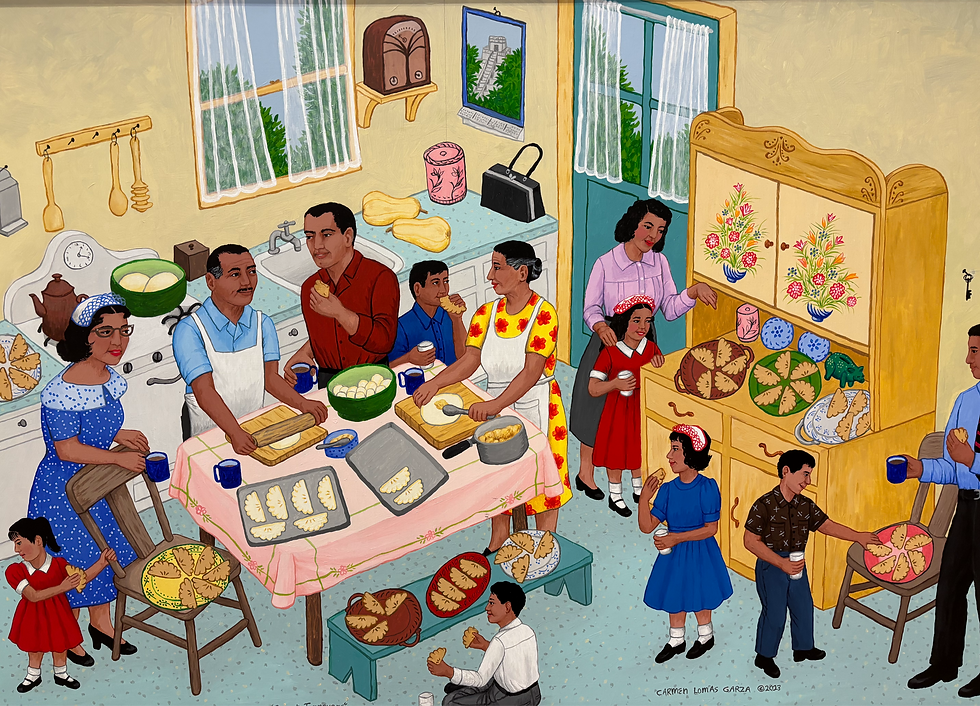
All in all, it is a visually and conceptually rich exhibition. As viewers exit the RCAF space, they enter a gallery dedicated to more recent art, including works by Los Angeles's Carlos Almaraz and San Francisco's Carmen Lomas Garza. Both artists followed RCAF's historic movement honoring Chicano art, history, and identity.
Rebels with La Causa: Royal Chicano Air Force Art and Activism, 1970–1990
Crocker Art Museum
216 O Street, Sacramento, CA 95814
February 22–June 28, 2026