


The Unbearable Lightness of Yoko
By Victoria Thomas
When John Lennon met Yoko Ono in 1966, he had no idea who she was. More remarkably, Yoko was equally unaware of John.
This neutral introduction seems impossible for us today, especially for children of the 1960s. But defying mere nostalgia, The Broad meets this challenge with Yoko Ono: Music of the Mind, Ono's first LA museum show, which offers a full season of multi-arts media programming, including the installation of seven digital antiwar billboards across Los Angeles. The exhibition runs from May 23 through October 11, 2026.
The Broad's exhaustive retrospective also gives us pause when re-examining Ono's legacy as a feminist. Her Half-a-Wind exhibition, which premiered at the Lisson Gallery in Marylebone, London in 1967, confronts us here at The Broad with a row of empty glass apothecary jars of varying sizes, each labeled "half-a-painting" and so on in Ono's exquisitely tiny, handwritten print. In interviews, Ono is quoted as saying that her estrangement from her then-husband (husband #2, before John) inspired the original exhibition, which was funded by Apple Corps with Lennon's consent. She described "...a half-empty space in my life" and later, for the 2015 New York MoMA retrospective, further opined that people "are just half," in search of their missing mate, the puzzle-piece needed to complete them. This opinion falls more in line with Hallmark Channel programming than with today's Fourth Wave.

Ono's deservedly celebrated Cut Piece and Wrapping Piece are referenced here through photographs. In the first, debuted by Ono in Kyoto in 1964, audience members used scissors to cut away the garments of a motionless, seated Ono. In the original 1961 Wrapping Piece, the audience was invited to wrap the artist in gauze "...until I disappear." Although these two extraordinary conceptual experiences have typically been hailed as expressions of feminist rage, their messages of identity-dismemberment and negation seem more existentially troubling than gender politics alone.
These two historic happenings will come to life again July 18 and July 19, 2026 as part of The Broad's creative alliance with REDCAT. Both works will be performed back-to-back at each staging. Los Angeles-based performance and visual artist MPA will appear in Cut Piece, while Sky Piece to Jesus Christ, one of several wrapping-related Ono projects, will feature the Los Angeles Chamber Orchestra (LACO) slowly losing the ability to play their instruments as they are gradually muffled, then silenced by yards of gauze. While Ono is praised for her optimism, these staged rituals of erasure speak of an immeasurable depth of loss. This undercurrent of grieving may also seem present in Ono film projects like Fly, as the familiar household pest explores the subject's skin, as is the case when a deceased body lies in final repose.

This is the woman who, in her own words, went from "bitch to witch" in the celebrity narrative. Chided by photographers for her steely reserve, Ono curtly replied that "Smiles are for shopkeepers," and when John Lennon took a bite out of the green apple in her 1966 installation Apple, reprised here at The Broad, she recalls being furious. This reported encounter is revelatory, since irreverent participation is precisely the premise upon which Yoko Ono: Music of the Mind purports to be based. By 1968, the couple had made the film Smile — 52 slo-mo minutes of Lennon's grin — evidence that their fated pairing in fact gave Ono much-needed permission to lighten up.

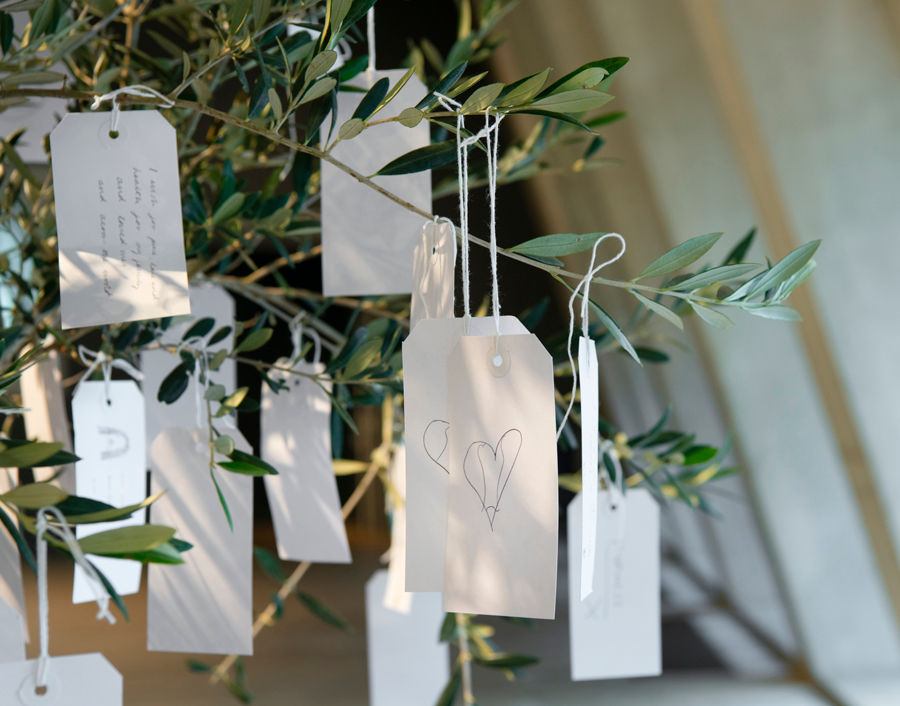
Yoko Ono: Music of the Mind invites hands-on interaction, especially refreshing since some elements included here, like Painting to Hammer a Nail, have previously been presented elsewhere behind a Lucite panel or other barriers preventing contact. At The Broad, visitors can engage by hammering loudly, and by using blue markers to adorn a small "Refugee Boat" and surrounding walls, writing mom-inspired sentences and attaching photographs of their mothers to waiting blank canvases, outlining their overlapping rear-projected shadows on a huge scrim, and by tying tags bearing written wishes to the Wish Trees on the museum grounds.
It must be said that these activities now resemble the excruciatingly cheery team-building exercises one encounters at company workplace retreats. Likewise, anyone who has spent much time in airports may twitch slightly at Ono's Half-a-Wind installation for its resemblance to those cornball souvenir cans of air from a designated city. Like Warhol, Ono dared to engage with the stultifyingly mundane and parade it into the rarified atmosphere of the gallery in the form of high art with a side of palate-cleansing kitsch. Ono's Julio Cortázar-like instruction-poems come to mind, which today seem prescient of IKEA furniture-assembly directions, so deliberately flat in their affect, often as clumsy in syntax as a poor translation from another language. As for the Warhol effect, the world can never again gaze upon a banana, a Campbell's soup can, or a Brillo pad in quite the same pre-Andy way.
Both artists initially appeared dry, enigmatic, sphinxlike to the public. Those not in on the joke wondered: "Are they kidding?"
To some degree, the answer may comprise Ono's most famous opening line, a monosyllabic incantation: "Yes." The single word "Yes," the handwritten text so small that reading it required a magnifying glass, was the centerpiece of Ono's 1966 exhibition at London's Indica Gallery that first drew John Lennon into her arms. Ono, Lennon, and Warhol became close friends, although Ono and Lennon ventured far deeper into openly emotional, often sentimental content than anything publicly revealed by the ever-deadpan, secretly tender-hearted Warhol.
Susan Sontag wrote that purveyors of camp see everything in quotation marks — nowadays we use air-quotes. While droll absurdist irony rules in Warhol, who famously gave the very young Sean Lennon a taxidermized cat as a birthday gift, Ono shares a similar sensibility in more cryptic bursts and flashes. Her art continues to engage, confound, even irritate, because she was among the first to mine the initially superficial as the coded hiding-place of something more.
Her alchemy is most successful when it ranges away from the literal. At her best, in Ono's hands the seemingly lightweight becomes heavy. A German army helmet piled with jigsaw pieces, parts of a puzzle comprising a photo of blue skies, makes its point in plain terms. But her white chessboards where both sets of pieces are white, making the ranks of mass-produced, plastic opponents identical and interchangeable, seem more quietly profound, and more disturbing.
For many of a certain age, John and Yoko seem as familiar as our parents — two war-babies who grew up to be counter-culture icons, with accompanying twinges, cringes, and noisy emotional baggage. Here and now, it is inescapably clear that modern war is not simply the ugly expression of amygdala rising, innately bloodthirsty human aggression, nor is it about anything as idealistic as keeping the world safe for democracy. As groups like the Council on Foreign Relations track 30 or so major ongoing wars and about 130 more smaller armed conflicts, John and Yoko's continued proclamation "WAR IS OVER if you want it" seems stunningly naïve. The streets of America and much of the rest of the world roil with anti-war and anti-fascism protests in historically record numbers, and yet the death tolls spin ever higher. Wanting and wishing, like well-meaning thoughts and prayers, appear to have no effect.
We do shudder a bit to recall that Lennon called his 1969 honeymoon with Ono, their first "bed-in," a "gimmick" and a "commercial for peace," saying "And we thought 'bed' because bed was the easiest way of doing it, because we're lazy."
But Ono's "Yes" insists and persists. Stranded at age 12 in the Japanese countryside after the 1945 Allied bombing of Tokyo, Ono recounts looking up at the clouds and sharing imagined meals and menus with her hungry younger siblings while local farmers threw stones or, at best, offered rotten potatoes. What some might call faith or hope, Ono called imagination — her psychic lifeline out of utter despair, from the loss of her home and Allied wartime imprisonment of her banker-pianist father in Hanoi, to a bitter custody battle for her first child, a daughter who was later kidnapped by the child's father Anthony Cox, to multiple miscarriages after marrying Lennon, to the era-ending 1980 murder of the former Beatle before her eyes. Misunderstood and vilified for decades, Yoko Ono: Music of the Mind persuasively reintroduces the oracular artist, now 93 and living in seclusion, as newly relevant and anything but a quaint relic.
Yoko Ono: Music of the Mind May 23–October 11, 2026 The Broad 221 S. Grand Avenue, Los Angeles, CA 90012 thebroad.org Information: 213-232-6200 Tickets: 213-232-6250
Victoria Thomas writes about pop culture and social justice. @miss_vickums


